Key points
- The FAA is deploying the SMART system across all 22 national air traffic control centres.
- Initial data from the Washington DC rollout showed average savings of 10 minutes and 80 gallons of fuel per rerouted flight.
The Federal Aviation Administration has expanded its artificial intelligence traffic management tool to cover the entire United States airspace system. This follows a limited trial in the National Capital Region that the agency describes as successful.The US aviation regulator is using a computer program to help manage air traffic across the whole country after testing it in Washington DC.The FAA is scaling its cloud-based predictive scheduling engine to all 22 en-route centres following a limited pilot in the National Capital Region.
The evidence
The agency claims these adjustments saved an average of 10 minutes and nearly 80 gallons of fuel for each aircraft.
The decision
In a statement posted on 10 November, the FAA confirmed it would use SMART in the airspace of all 22 centres across the country.reported The agency says this expansion aims to reduce delays, lower fuel consumption and improve the travel experience for passengers.
Evidence: reported
FAA expands AI advice to manage air traffic congestion across entire US airspaceaifleet-ars
The takeaway
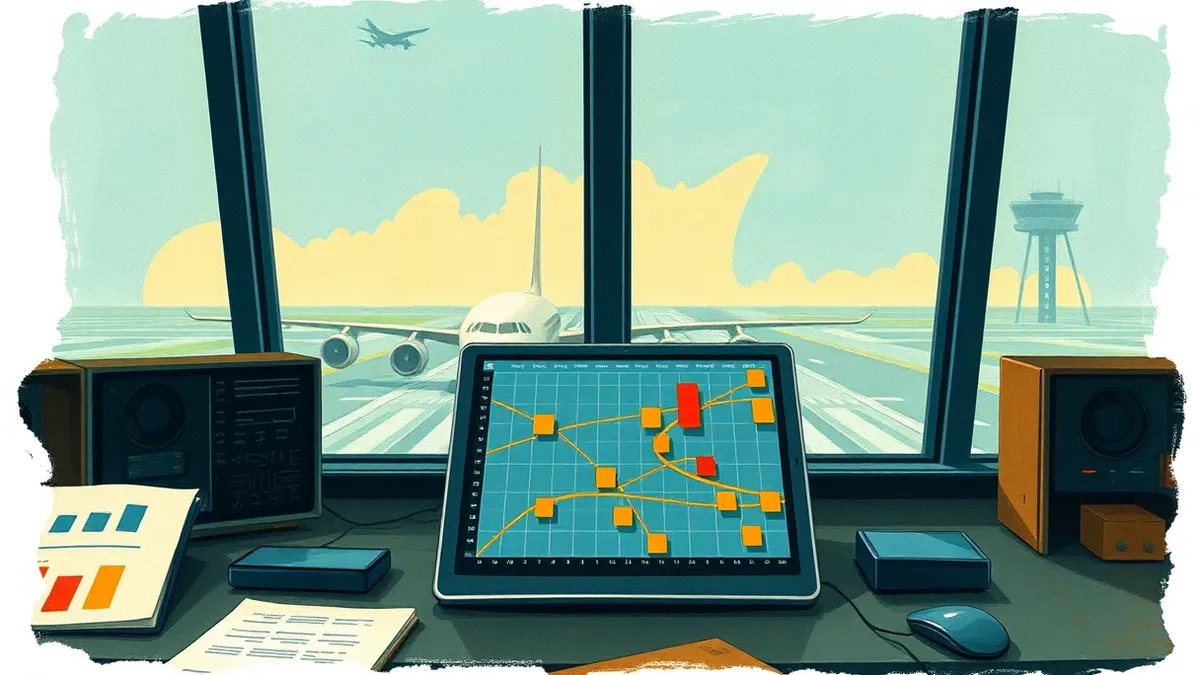
The system combines weather patterns, flight paths, traffic flow and controller staffing metrics to predict air traffic patterns. It provides scheduling recommendations and identifies optimal routes, but local controllers can reject these suggestions.
Building on this
Developers can build decision-support interfaces that aggregate multi-source operational data to generate probabilistic recommendations for complex scheduling problems. The documented architecture shows how cloud-based AI can process real-time variables like weather and staffing to suggest optimal sequences. However, the system’s limits are clear: it cannot replace human oversight or take direct control of assets. Builders must design for human-in-the-loop validation, where specialists review AI outputs before they reach operational teams. This pattern applies to any high-stakes logistics platform where automation aids rather than replaces decision-makers.
Why it matters
- Enterprise buyers see a concrete example of AI assisting rather than replacing human operators in critical infrastructure.
- Reported fuel and time savings provide measurable KPIs for evaluating the ROI of similar AI scheduling tools.
- The ability for local controllers to reject recommendations demonstrates a necessary safety override in automated systems.
Topics: aviation, AI, FAA, logistics, automation
Updated
Then / now / next
The SMART system was limited to airspace over Washington DC following a September rollout.
The FAA is deploying the tool across all 22 national air traffic control centres.
The National Air Traffic Controllers Association says it was not involved in the design, testing or implementation of the system.
Story timeline
- Then The SMART system was limited to airspace over Washington DC following a September rollout.
- 12 Nov 2026 FAA expands AI advice to manage air traffic congestion across entire US airspace
- 13 Nov 2026 FAA expands AI advice to manage air traffic congestion across entire US airspace
- Now The FAA is deploying the tool across all 22 national air traffic control centres.
- Next The National Air Traffic Controllers Association says it was not involved in the design, testing or implementation of the system.
Ask the article
Local keyword search of this article; no generated answers.Did this article give you the evidence you needed?
Your choice stays on this device. No public tally.Questions readers ask
Can the SMART system control aircraft directly?
No, the FAA states the system cannot take over control of an aircraft or replace the role of air traffic controllers.
Which union represents the air traffic controllers?
The National Air Traffic Controllers Association represents more than 15,000 members and was not involved in the system's development.
How much did the initial SMART system cost?
The FAA states the system cost $875 million.
Connected stories
Reading receipt
- The FAA is deploying the SMART system across all 22 national air traffic control centres.
- Initial data from the Washington DC rollout showed average savings of 10 minutes and 80 gallons of fuel per rerouted flight.