Key points
- GR00T 2 uses a world-action model to predict future video frames alongside motor movements, enabling transfer between robot form factors.
- Lab tests showed success rates between 10 and 80 percent, with some tasks requiring less than three minutes of additional conventional training.
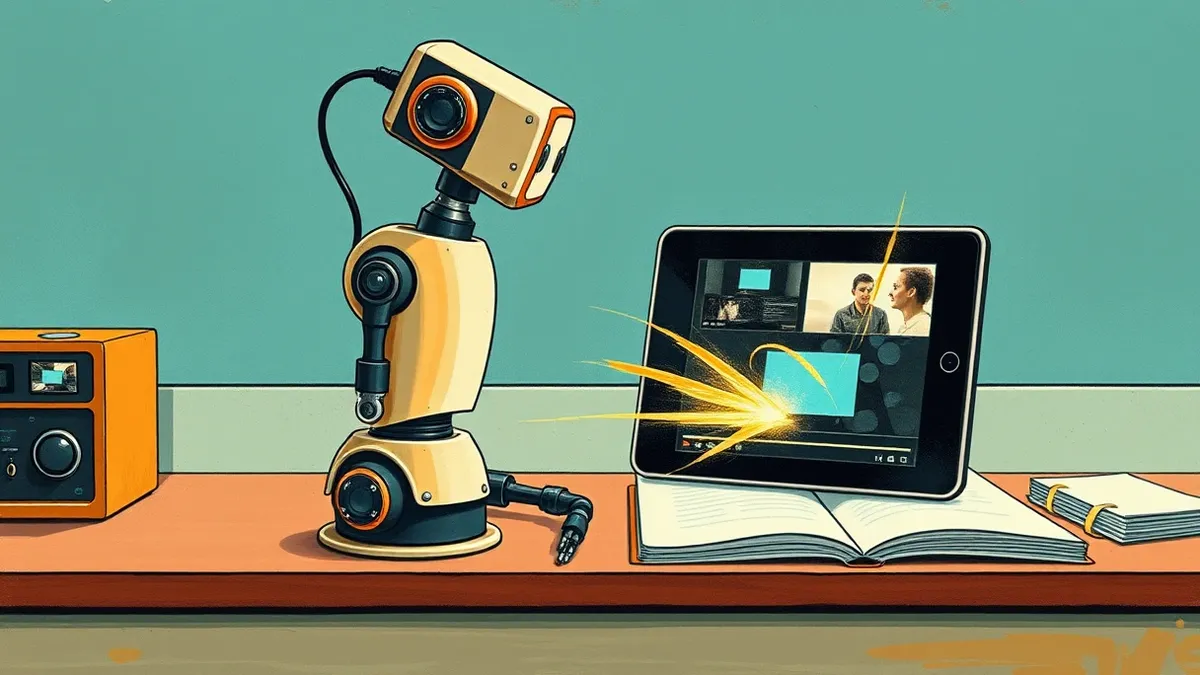
Nvidia has released details on GR00T 2, an AI foundation model designed to teach robots new tasks by translating human movements captured in video.reported According to a report by The Decoder, the system aims to eliminate the need for laborious and expensive teleoperation during the training phase.reportedThe system learns by watching humans in videos, then teaches robots to copy those actions without direct remote control.The model employs a world-action architecture to predict future visual states and motor commands, facilitating cross-form-factor motion transfer.
Evidence: reported
Nvidia's model GR00T 2 watches humans on video, then imagines itself as the robotaifleet-decoder
Evidence: reported
Nvidia's model GR00T 2 watches humans on video, then imagines itself as the robotaifleet-decoder
The evidence
The Decoder reported that engineers traditionally spend hours remotely controlling machines to generate training data for each specific robot model.reported GR00T 2 attempts to shorten this process by using a different architectural approach than its predecessor, GR00T 1.reported Instead of directly converting camera images and language commands into motor movements, the software operates as a world-action model.
Evidence: reported
Nvidia's model GR00T 2 watches humans on video, then imagines itself as the robotaifleet-decoder
Evidence: reported
Nvidia's model GR00T 2 watches humans on video, then imagines itself as the robotaifleet-decoder
This model simultaneously calculates the next physical movement and generates a short video prediction of the immediate future. For example, it predicts how the camera view should change when a robotic arm picks up an object. This capability allows the system to transfer movement sequences between different robot form factors, according to the published reportreported
Evidence: reported
Nvidia's model GR00T 2 watches humans on video, then imagines itself as the robotaifleet-decoder
The decision
The footage shows people performing various tasks while wearing head-mounted cameras. The Decoder noted that this massive dataset forms the basis for the model’s ability to understand human motion and translate it into robotic actions.
The takeaway
In lab tests, a robot with five-fingered hands successfully lit a match, sliced a banana, and tossed packages onto a conveyor belt without specific teleoperation for those tasks. Success rates varied widely, ranging from 10 to 80 percent depending on the specific task.reported For 50 selected tasks where the model performed well after few examples, less than three minutes of conventional training raised the success rate from 40 to 95 percent.reported
Evidence: reported
Nvidia's model GR00T 2 watches humans on video, then imagines itself as the robotaifleet-decoder
Evidence: reported
Nvidia's model GR00T 2 watches humans on video, then imagines itself as the robotaifleet-decoder
Building on this
Developers can integrate GR00T 2 to reduce the data collection burden for new robotic deployments.reported The model allows for demonstration via data gloves, specialized hand grippers, or finger exoskeletons, which are then combined with general motion data from the target robot. The AI generates the robotic arm in its video prediction and derives control commands from that simulation. For longer assembly work, Nvidia pairs the system with a higher-level language model, such as OpenAI’s GPT-6 Astra, to help manage errors, although this addition slows down the robot’s operation.reported
Evidence: reported
Nvidia's model GR00T 2 watches humans on video, then imagines itself as the robotaifleet-decoder
Evidence: reported
Nvidia's model GR00T 2 watches humans on video, then imagines itself as the robotaifleet-decoder
Why it matters
- Enterprise IT buyers can reduce the high cost and time associated with teleoperating robots for every new task or form factor.
- The variability in success rates (10-80 percent) indicates that critical industrial applications may still require significant additional fine-tuning or safety overrides.
- The requirement for specialized input devices like data gloves or exoskeletons adds hardware complexity to the demonstration and training workflow.
- Integration with large language models for error handling introduces latency, which may impact real-time performance in fast-paced manufacturing environments.
Topics: robotics, Nvidia, AI models, automation, machine learning
Updated
Then / now / next
Engineers spent hours teleoperating robots to generate unique training data for each model and task.
GR00T 2 uses video-based world-action modelling to transfer human movements to robotic arms with varying success rates.
Developers will need to assess whether the 10-80 percent success rate range is acceptable for their specific industrial applications.
Story timeline
- Then Engineers spent hours teleoperating robots to generate unique training data for each model and task.
- 10 Nov 2026 Nvidia's model GR00T 2 watches humans on video, then imagines itself as the robot
- Now GR00T 2 uses video-based world-action modelling to transfer human movements to robotic arms with varying success rates.
- Next Developers will need to assess whether the 10-80 percent success rate range is acceptable for their specific industrial applications.
The strongest doubt
Counterpoint from the sources
Success rates vary significantly, dropping to 10 percent for some tasks, which limits immediate reliability for precision industrial work without additional training.
Ask the article
Local keyword search of this article; no generated answers.Did this article give you the evidence you needed?
Your choice stays on this device. No public tally.Questions readers ask
What hardware is required to demonstrate tasks to GR00T 2?
Users can demonstrate tasks using data gloves, specialized hand grippers, or a finger exoskeleton, according to the report by The Decoder.
How does GR00T 2 differ from GR00T 1?
GR00T 2 acts as a world-action model that predicts future video frames alongside movements, whereas previous approaches translated images and commands directly into motor movements.
What is the training data volume for this model?
Nvidia trained the system on approximately 400,000 hours of video footage showing people performing tasks with head-mounted cameras.
Connected stories
Reading receipt
- GR00T 2 uses a world-action model to predict future video frames alongside motor movements, enabling transfer between robot form factors.
- Lab tests showed success rates between 10 and 80 percent, with some tasks requiring less than three minutes of additional conventional training.
Still open: What specific tasks resulted in the lowest 10 percent success rates?
Still open: How much additional compute is required for the paired language model during runtime?